Introduction
To truly appreciate a Kathakali performance, one must begin with the transformative ritual that happens backstage—the application of makeup. At Punarjani Traditional Village, guests are invited to arrive early and witness this fascinating process, known as Chutty Kuthu. It is here that mortal artists begin their metamorphosis into gods, demons, and legendary heroes.
The Magic of the Makeup
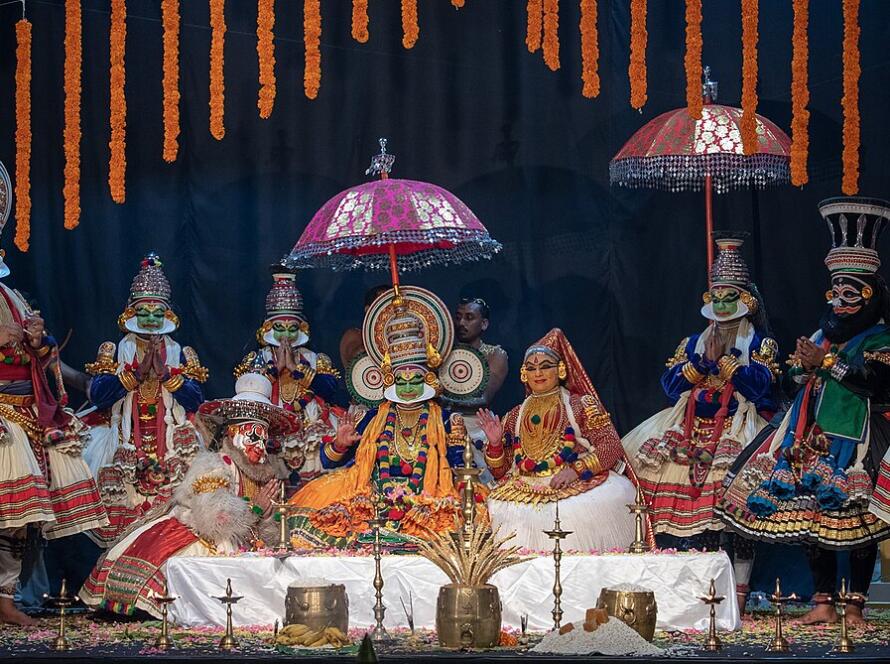
The elaborate makeup and costume of a Kathakali artist are central to the storytelling. The character’s nature is revealed entirely through the colours and patterns painted onto the artist’s face. The makeup process is a sacred art in itself, taking about two to three hours to complete . During this time, the artist lies on their back as the chutty artist (makeup specialist) works meticulously.
Understanding the Colours (Vesham)
The use of specific colours is a symbolic language in Kathakali, classifying characters into several distinct categories :
- Pacha (Green): This is the noble make-up, representing virtuous and heroic characters. The predominant green colour, contrasted with a red border on the lips, signifies kings and divine beings. Characters like Lord Rama and Krishna are depicted in Pacha Vesham, denoting their sattvic (pious) and rajasik (kingly) nature .
- Kathi (Knife): This makeup is for arrogant and evil characters who possess a degree of valour. While the face is green (indicating a high birth), a red, knife-like mark is painted on each cheek, signifying their wicked nature. The demon king Ravana is a classic Kathi character .
- Thaadi (Beard): This category is further divided into three types:
- Chuvanna Thaadi (Red Beard): For vicious and excessively evil characters, with black and red faces, like the demon king Bali.
- Vella Thaadi (White Beard): A rarer type used for higher beings, most famously for Hanuman, the monkey god, who embodies strength and devotion.
- Karutha Thaadi (Black Beard): For primitive beings, such as forest hunters and dwellers .
- Kari (Black): This is for the most gruesome demonic characters. Their faces are painted jet black with white and red dots, representing darkness and evil .
- Minukku (Radiant): This makeup represents gentle, high-spiritual beings like sages and women. It is a softer, more natural-looking makeup, showcasing high spiritual qualities and contrast to the more flamboyant types .
The Chutty (The Paper Mask)
A crucial element of the makeup is the Chutty, a white paper mask that borders the artist’s face, extending outwards to create a dramatic frame . Historically, rice paste was used for this purpose. However, in a revolutionary invention in 1929, Thiruvella Ramakrishna Panicker introduced thick bond paper as a substitute. This change has become a standard feature, adding a remarkable geometry and ethereal aura to the character .
The Costumes and Headgear
The elaborate costumes are equally significant. The circular crowns, called Kiritam, and the heavy, multilayered skirts are designed with remarkable geometry and proportion. The way an artist moves in these heavy costumes is a testament to their years of rigorous training .
Why Witness This Ritual?
The makeup process is more than just preparation; it’s a part of the theatrical experience. It bridges the gap between our world and the world of the epic, where the divine and the demonic are real. At Punarjani Traditional Village, watching this art form come to life is an honour that gives you a unique insight into the dedication and reverence of the artists. The venue opens its doors early for guests to observe this process, creating a truly immersive cultural experience .